Thursday, March 28, 2013

From Iowa to Ireland


As a museum volunteer, I’ve been able to do all kinds of things: clean mammoth bones caked in dirt thousands of years old (more fun than it sounds), lead tours about Iowa’s natural past, teach children about topics like astronomy and dinosaurs, and slowly collect a colorful cornucopia of Rusty shirts. Unfortunately, none of these things can be done on my semester abroad in Ireland, although I did pack a Rusty shirt—however, my semester in Ireland has given me a fantastic opportunity to learn about another country’s past, both natural and archaeological.


At first glance, Iowa and Ireland don’t look alike at all.  After all, Iowa has rolling hills and farmland, bounded by two rivers, but otherwise mostly landlocked; Ireland is a perpetually green island ringed with pebbled beaches and craggy mountains.  But Ireland was once underwater, like Iowa, and a trip to the Ulster Museum in Belfast reveals Ireland’s underwater past: like Iowa, Ireland was home to corals and crinoids, prehistoric cephalopods and ammonites. The water gave way to a more arid climate, and Ireland’s watery past ended up in marine fossils. 


But Ireland was once covered in glaciers, too; it’s hard to believe that a country so green and vibrant now could have once been barren and icy, but just as Iowa was once glacial, so too was Ireland. When the glaciers receded around ten thousand years ago, they changed Ireland’s landscape – where the glaciers gave Iowa its gently rolling hills, it gave Ireland some of its craggiest mountains and shorelines. And just as I teach children about Rusty, who couldn’t survive when the ice melted, Ireland is home to its own Rusty – this giant deer, for example, who was the largest deer to ever have lived, and went extinct around ten thousand years ago. (Ireland was home to plenty of other arctic animals as well, not all of which survive today.)

It’s easy to think that because Iowa and Ireland – or any two places on the globe – are far away, home to different landscapes and people, that they’re profoundly different places, now and forever. But the beauty of the natural world is that it’s always there, no matter where you are; we’re always surrounded by reminders of what came before, and what surrounds us now.

Sometimes those reminders take different forms: a volcano that erupted some 50 million years ago left Ireland’s north coast with a ‘pavement’ of forty thousand interlocking basalt columns, otherwise known as ‘the Giant’s Causeway.’ If you can keep yourself from slipping on wet stone, you can chart a path across the columns, which have withstood the test of time, a monument from a long ago past.
 
 
But elsewhere, the natural world I encounter in Ireland is similar to what I know best - what I get to work with at the museum. The Ulster Museum, for example, is home to plenty of birds, some of which live in Ireland permanently and some of which migrate throughout the year—similar to Hageboeck Hall of Birds, which is also home to birds native, and not native, to our state.  The Ulster Museum is also home to clay pots made by Ireland’s first settlers, and if you placed those pots next to the ones in Iowa Hall, only a trained archaeologist could tell you which came from where.  

Museums are there to tell us about places different from our own: a trip through Iowa Hall is, after all, a trip through a world long gone. But natural history is always with us, and as my travels in Ireland have proven, sometimes natural history is more universal than you think. 
 
-Written by MNH Volunteer Catherine Babikian

Thursday, March 21, 2013

Sitting Beneath Mullet Pond


Count me among those who never expected to find a whale hidden at the heart of Iowa City. The ocean is 1113 miles away due east, and yet farther to the west. But, here I am and here is the whale. The massive skeleton of a whale, at least, hanging above my head.

Sitting and typing on this wooden bench amongst the dozens of other skeletal specimens that inhabit one end of Mammal Hall, I look up through its cavernous ribcage and into the skull, an arching maxilla with a jaw like two tusks, altogether about the size and shape of a helicopter cockpit. It is a 42-foot long, 4,400 pound, century-old right whale, and I am peering into its skeleton, counting the fifty vertebrae that span its steel rod spine and marveling at its many-knuckled hands not so different from my own.

It is a lady whale, and her name is Mullet Pond.

Mullet Pond, after the coastal landmark whereupon North Carolina whalers proudly beached the leviathan on Valentine’s Day, 1898.

Instructor and former museum employee Will Thomson documents the tale, how it took over forty men of the Red Oar Crew to harpoon her and bring her ashore, and how they rendered her there on the beach. She “yielded over 750 pounds of baleen and over thirty barrels of whale oil.”  An East Coast taxidermist would travel 150 miles to bargain for the bones—flesh-stripped bones with an aroma like a “factory that had been turned into a home for unexpurgated skunks”—and then he would send them inland by train, disguised as fertilizer material for cheaper freight, to museum father Charles Nutting, professor of zoology at the State University of Iowa. But this was only the beginning. For 12 years the skeleton of Mullet Pond would be stowed away in a campus attic, unassembled, boxed in crates, and largely forgotten, awaiting the construction of Macbride Hall and the industrious knack of exhibit designer Homer Dill, who would order the hundred-odd pieces and mount them to the ceiling of the gallery above my wooden bench.*

Barred and bolted straight into the rafters, it is hard to think that Mullet Pond could have been anything less than eternal fixture of Macbride Hall, perhaps even the skeleton of the building itself, just missed by the plaster and paint. But she is not. She was brought to this building. She has an origin, a story that precedes her arrival here in landlocked Iowa.

And this I find fascinating—not just the long narrative of the whale, but more so the fact that she has one to begin with. Mullet Pond was once a skeleton in a body. She was a living, swimming, geyser-breathing animal. Even in a gallery full of exhibits designed to display taxidermy within its natural scene, it is too easy for one to forget that these specimens are more than sculpture behind glass. Though they are extracted from nature, the same flesh once blushed with blood. They must not be utterly disjoined from the world just because they are now on display to it. Notice the hole in rib of the moose—it is the mark of a bullet. See the form of a young human being—it once had a name, a face, a mind. None of the exhibits have been exhibits forever. They are the time-frozen vestiges of real stories.

In the stories, an entire museum is given a new sense of life.
-Nathan Kooker, MNH Volunteer 
 
*
Thomson, Will. "A Whale for Iowa." Palimpsest 1987: 50-59.


Tuesday, December 11, 2012

DINO-mite Time at Night at the Museum!

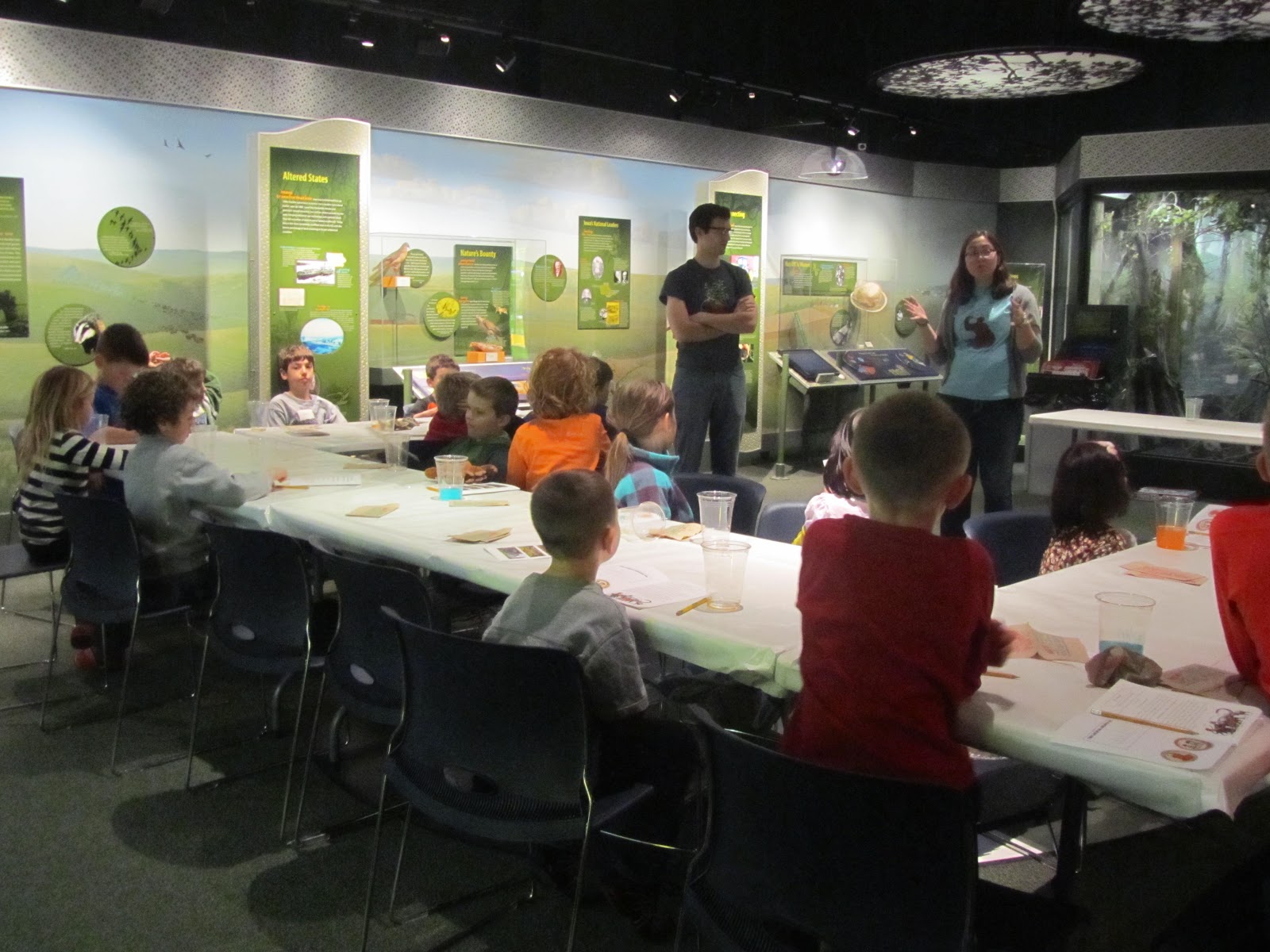
This Friday, seventeen children brave a dreary Iowa evening to come to the museum and dig for dinosaurs, at the last Night at the Museum for 2012.  In Iowa Hall, they race each other across the museum (while wearing “dinosaur feet” slippers) and wait for the others to arrive. Some of them know quite a bit about dinosaurs already – able to name the difference between a Tyrannosaurus rex, a velociraptor, a steogosaurus – others (like me) know comparatively little. 

After the races subsist and pizza and juice devoured in Bird Hall, the children begin the first dinosaur related activity – becoming miniature paleontologists. We take a moment to talk about what a paleontologist does: they dig up prehistoric animals, like fossils or woolly mammoths, out in the field, then study them in their labs.  Most of all, we talk about why a paleontologist does their job: why dig up old animals when there’s so much new to explore? Why take the time to carefully retrieve the bones from the wild, clean them off with care, run tests on them and make models for museums?

Each child gets a plate covered in sand and fossils – they have to use a plastic spoon to carefully retrieve their fossil from the sand. Some children dig right in, pounding the sand to try and find their fossil, but others, in true paleontologist form, take more time, scraping past the layers of dust to come up with a dinosaur head (albeit plastic).  Like real paleontologists, they want to know what kind of dinosaur they have – sure, the dinosaurs have been in the sand (although only for a day or two, not millions of years), but that doesn’t mean the children can’t learn from them.  Real bones found in the wild, and even their plastic counterparts, have much to tell us about an Earth that’s radically different from today. We’ll never get to see it in our lifetimes, but we can always make a good guess, which is what paleontology is about.

Later on – after trips through Bird and Mammal Hall, as per tradition – the children come back to the discovery hub to try their hand at fashioning their own dinosaurs.  The floor covered in all kinds of craft materials, from pipe cleaners to plastic jewels to paper and scissors, the children grab everything they can in a minute and then set to fashioning their own dinosaurs.  Some of them are crafty; others aim for a basic dinosaur that can “get the job done.” All of them twist their pipecleaners and add their clothespins, trying to make the best dinosaurs possible.  (Children are infinitely better at these kinds of things – my dinosaur is only a dinosaur if you tilt your head to the left and squint; my dinosaur will not be roaming the wild anytime soon.) 
The amount of children at Friday’s Night at the Museum points to our never-ending fascination with dinosaurs – and the world of the dinosaurs by proxy.  One child asks why the dinosaurs went extinct, and others name off the theories: a volcano, an asteroid, disease, the food chain bottoming out.  Yet the truth is that we’ll never actually know.  When so much of science and history are based on facts – certain chemicals do certain things when mixed together, or certain events happened at one particular time and place – the dinosaurs, and their faraway, forest world, elude us, no matter how much we uncover.  After all, we only have the bones they left behind, and the rest is guesswork: but it’s fascinating guesswork nonetheless.

-Written by MNH Volunteer Catherine Babikian

Tuesday, November 27, 2012

Meskwaki- An Important Piece of Iowa's History

When we think of natural history, we tend to imagine fossils and fish, animals with ferocious teeth or giant claws, old bones and shark teeth. I think of Rusty and his friends – the mastodon, the woolly mammoth – and the Devonian section. 
But natural history is more than just the history of extinct animals – it’s a way to catalogue our world, even as it changes.  At the tail end of the Iowa Hall gallery – past the prehistoric fish, the swampy jungle, and Rusty himself – you’ll find a diorama of a Meskwaki settlement, circa 1850, or right after Iowa became a state.  It’s an important marker of Iowa’s past, and filled with interesting artifacts to explore.
 
In the main diorama, an old man teaches a young boy how to carve wood – they sit inside a winter lodge, which the Meskwaki built every winter, using a wooden frame and a covering made of dried cattails.  Nearby, a woman makes a dye (although it looks like she’s cooking).  Her cotton dress, and the wool blanket inside the lodge, point to ongoing trade with settlers – after the first forays of Marquette and Joliet, the first explorers to set foot on Iowa soil, trade among Native Americans and settlers was inevitable. 
Yet I find the more interesting artifacts in the nearby cases.  Beaded artwork abounds – the beads were obtained via trading, but the artwork itself is entirely Meskwaki.  Bows and arrows – even toy arrows for young boys to practice with – and children’s toys cover the bottom of the gallery. And perhaps the most interesting artifact is the necklace made of bear claws and fur.  Only worn by tribal leaders, the bear claw necklace is made from twenty to thirty bear claws, but the claws have to come from a specific paw, so that each bear claw necklace comes from four or five bears.
It’s easy to get distracted by Rusty and Dunky, the vast dioramas that seem to take us to another time – sometimes, the Meskwaki exhibit seems like yesterday in comparison. But what happened yesterday is just as important as what happened last week, or three weeks ago, or three million weeks ago. Iowa’s history is both prehistoric and historic – made up of both the fossils and geodes we unearth from the soil, and the people who came to live here before us, who left traces of their life behind, so we might someday know about who walked in our footsteps.  Shells and arrowheads, projectile points and milling stones: just as fossils and bones tell us about the animals who prowled around, so too do these artifacts.
After all, we weren’t the first ones to set up shop in Iowa. Who wouldn’t want to know about those who came before? That’s what the museum is for.

-Written by MNH Volunteer Catherine Babikian
Tuesday, November 20, 2012

How to Stump a Set of Scientists


To say we were stumped when a visitor stopped by with this object on Friday would be an understatement.  As you can see from the picture, it’s mostly spherical, about 5½” in diameter, and shiny, as if its been polished.  You can’t tell this from the picture, but it’s pretty lightweight, and the impression you get if you pick it up is that it’s hollow.  It was found floating in the Des Moines River about 60 years ago, and the owner stumped museum staff with it then as well.  This time, he asked staff at the UI Paleontology Repository and the Museum of Natural History before someone at the Office of the State Archaeologist finally solved the puzzle. 

We think this is an enterolith, or intestinal stone, presumably from a horse (our research suggests that they are common in horses, but found in some other animals too).  Enteroliths are a lot like gallstones or kidney stones in people, and also something like pearls in oysters.  They form in a horse’s intestines when the chemical conditions are right.  Most enteroliths seem to be formed of a mineral called struvite (ammonium magnesium phosphate), which forms crystals in concentric rings around some starting “seed” (as a pearl does around something like a grain of sand).  Horses seem to get them when they’re eating relatively high concentrations of protein (for example from alfalfa), which generates ammonium ions, and magnesium.  So enteroliths are more common in some places than others because the minerals in soil and water are different and because common food sources are different.  Small enteroliths can be passed naturally, but large ones need to be removed surgically.  According to an equine vet we asked about this, they are often much larger than this one, and they’re usually quite solid and heavy—they are, after all, stones!  That means we haven’t quite solved the mystery of this enterolith (if that’s what it is), because it feels light and hollow.  We wonder whether the mineral crystals inside the enterolith could have been dissolved by immersion in the river, leaving the hard shell… and if any chemists, veterinarians, or taphonomists out there want to do this experiment, we look forward to hearing what you find.

-Written by MNH Associate Director Trina Roberts
 
Examples of other enteroliths

Tuesday, November 13, 2012

A Visit to Undersea Iowa


A trip through Iowa Hall is very much a trip through Iowa’s past – step in the galleries and you’ll see Iowa before it became farmland, before highways and roads began to criss-cross the state, before Iowa City was even a city at all. 

After many, many trips through Iowa Hall myself, I’ve decided that some exhibits in the gallery are easier to fathom than others.  We know of the Native Americans who used to live on the land, before settlers came; we can even believe that Rusty, tall and large as he is, used to live in an Iowa covered by glaciers.  (After all, sometimes the winter feels like the Ice Age.) But it’s harder to believe that Iowa was once a tropical swampland, and that it was once underwater, harder still.

The Devonian exhibit is the first in Iowa Hall, and it’s a true glimpse into an Iowa that’s long gone: Iowa from 360 million years ago, covered in shallow, sunny waters, filled with ancient cephalopods and armored fish? It’s true.

The armored fish in question would be Dunky – short for Dunkleosteus – a prehistoric fish who used to rule the seas. We think sharks today are scary, but a shark would have paled in comparison to Dunky (there is a shark in the Devonian exhibit, but it’s far smaller), who as an adult would have been two stories tall and the length of a school bus.  He could open his jaw as wide as it would go, and it would create so much pressure that anything in the vicinity would have been sucked in – this even included other fish.


Trilobites, the first animals to develop eyes, were around in this period, too – although they went extinct at the end of the Devonian, the exhibit is home to many – as are ammonites, which also went extinct.  Ammonites, which look similar to cephalopods, had huge, hollow shells, and the ammonite could slide its body in and out, controlling its buoyancy and position in the water.  If it’s hard to believe these animals really existed, it’s harder to believe they once lived in Iowa, a place very much out of water – but the fossils never lie. 


Dunky and the trilobites aren’t the only things in the exhibit – there are plenty of animals that today you might find on coasts or coral reefs. Huge expanses of coral, like what today you might find in Australia, cover the exhibit, as they would have covered the ocean floor (coral, interestingly enough, is actually an animal).  My favorite, however, would have to be the crinoids, or sea lilies.  They look like underwater flowers, but are actually delicate animals that use the ocean currents to catch small, microscopic organisms to eat.

But it’s this varied, sometimes unbelievable history that makes Iowa’s past interesting – it’s the idea that Iowa hasn’t always been farmland and rolling hills, but instead a glacial paradise, a quasi-rainforest, or a shallow sea.  And that’s why, even after countless trips, Iowa Hall is still a fascinating place – we’ll never get to see Iowa as anything but prairie and farmland, but step through Iowa Hall and you’ll get amazingly close.

-Written by MNH Volunteer Catherine Babikian

Tuesday, October 30, 2012

A Night of Fun at Creepy Campus Crawl

For weeks, the word – or words – of the day have been “Creepy Campus Crawl,” the Halloween event that the museum puts on every year.  This year’s theme is Nintendo, and the museum is flush with talk of Mario and Luigi, Pokemon and Zelda, stations and activities.  Just as they have every year, children start to pour in right at 6:30, dressed as characters from Nintendo, Harry Potter, Doctor Who, or whatever character they can dream up.  (One child comes dressed as a vampire bat.)


In the front lobby, they meet some of the most classic Nintendo characters - entering a raffle with the Ice Climbers, throwing fireballs with Mario and Luigi, meeting Princess Peach.  Packing peanuts – the snow that the Ice Climbers have to climb – litter the floor, to be tracked all around the gallery, but nobody seems to mind.  Today, the museum is hardly the Museum: it’s instead a place of characters and costumes and candy, and everybody knows it.

When they leave the front lobby, the children make their own Pokemon in the Devonian and Pennsylvanian, aided by the Pokemon trainers, who have put together an impressive array of characters.  Although the Ice Climbers might not be familiar to all children, Pokemon is hard to miss.  Elbowing each other for room at the tables, the children color in their own Pokemon cards – some very detailed, some a quick dash - and then hand them to their parents to carry.

 
In the Meskwaki area, decorated with fluffy clouds to represent the world of Kid Icarus, the children wrap aluminum foil around paper plates to make mirror shields, assisted by Palutena and Medusa, the main goddesses from the game.  When they finish, Pit, the game’s hero, shines a flashlight on the shield to make it shine, and the children head to the Ecology section to build rockets with the Pikmin.   
There’s more fun to be had downstairs – where the Geoscience department has set up shop – and in Bird and Mammal Halls – where you can find rupees with Zelda and play skeeball with the cast of Earthbound – but no matter where you decide to go, there’s always something to do.  Each child leaves with an assortment of crafts – shields, Pokemon, rockets – and an evening well-spent.  And since Halloween falls on a Wednesday this year, it’s only the start of an extravaganza.

 
Halloween is that rare holiday where, for a few hours, you can pretend to be someone else.  No matter the strength of the disguise – after all, the scary looking ghoul is always a child underneath – it’s about the fun of playing pretend, of dressing up, of trick-or-treating and pumpkins and ghosts.  For a few hours, you can climb with the Ice Climbers or write yourself into the Legend of Zelda; it only happens once a year, which makes it all the more worthwhile.  

-Written by MNH Volunteer Catherine Babikian